
Birding in Bhutan
Six of us, Jayantika, Himanshu, Alpa, Rajindra, Nikhil and I, have just returned from a birding trip where we watched the sun rise with the Himalayan Monal and Blood Pheasants, had breakfast with the Satyr Tragopan and lunch with Black-throated Parrotbills – yes, happiness is a place, and its name is Druk Yul- land of the Thunder Dragon, or Bhutan.
(While I am trying to keep this report down to the memorable highlights, you can probably deduce from the Part 1 in the heading that it will be a long rambling one. If you would like to cut to the chase, please scroll down to the end and the bird list)
When you fly in to Paro, you already get a feeling that you are going somewhere very special, a kingdom guarded by no other than the mighty Himalayas. The peaks reach out to you, Mt Everest breaking through the thick cloud cover and showing its summit, the vast timeless range inspiring awe and putting into perspective our small problems and everyday struggles. The very geography of Bhutan invites one to step out of our petty concerns and become a part of the larger whole, just as the Buddhist Bhutanese people attempt to. They strive for and measure their success with an index of Gross National Happiness over Gross National Product. They look elegant and dignified in their traditional clothes and their towns and villages have beautiful homes with traditional facades, painted with good luck symbols. Mountain streams automatically turn prayer wheels as the waters flow and the winds blow the prayer flags in the five colours of the elements, showering blessings upon the land. Shopkeepers offer products and receive payment with two cupped hands, much in the same way as we distribute and receive prashad. Extra food is shared with people working on the roads and leftovers are served to the stray dog who visited you at lunch time. This is a people that are trying to modernise and yet retain their core values and traditions, and conserve their cultural and natural heritage. This is a land that still has seventy-two percent forest cover and hence it is possible for you to watch the sun rise with the Himalayan Monal…………..
Our arrival was dependant on the largess of the Thunder Dragon, would he lift the cloud cover and permit our plane to land on the small airstrip in the valley between the mountains? After half an hour of circling our pilot dextrously brought us down. We reached our hotel, unpacked and donned a few more warm layers and set about to explore. In the compound, the House Sparrows had been replaced by Russet and Eurasian Tree Sparrows, House Crows by the Large billed Crows and Red billed Choughs. A White collared Blackbird greeted us as we drove to the quaint town centre where we were delighted to find that the Indian Rupee and Hindi both worked wonderfully well. An afternoon stroll by the river gave us a glimpse of an Ibisbill flying past, a pair of Goosanders (Common Mergansers) tried to sleep as the wind ruffled their feathers, River Terns and White Wagtails walked on the stones while Rufous breasted Accentors sat in the bushes. We drove through roads dotted with blossoming trees, shades of pink and white, to an apple orchard, the favourite haunt of the Black-tailed Crake. It being Day 1, we were on our best birding behaviour and waited patiently for some sign of the crake. At last, his call was heard. More waiting, and in true crake-like fashion, he emerged briefly and disappeared back into the grasses. More waiting, and finally in the fading light, he came out and walked in the water channel giving us time to see his fluorescent yellow-green beak and black tail. A 3 am wake up meant that we got into bed early only to arise again the next morning at 3 am to drive to Chele la.
Chele La @ 3988 mts
We set out in darkness, winding up the mountain roads, half asleep, until a Spotted Nutcracker called and the first light revealed an enchanted alpine forest. Conifers stood tall, their branches weighed down by freshly fallen snow. Lichen hung from the trees like beards of wispy green spider’s webs. Icicles gleamed under overhanging roots and in this pristine white, green and brown landscape a few shrubs added colour with red stems. As we walked the snow crackled beneath our feet while fresh flakes fell gently from above. This was a charmed forest reminding one of fairy tales and wizards and only magical creatures could live here. And sure enough, the first among them moved behind the shrubs giving tantalising glimpses of iridescent colours – green, copper, purple, cinnamon brown- all packaged to make the most amazing pheasant, the Himalayan Monal. He tantalised by moving under cover and we followed his every movement, hoping for a clear view. He left us then, wanting more, and fortunately for us we did get to see at least five more male Monals, as well as a few females, in flight, walking and climbing out in the open, so that we could admire them to our hearts content. At one gully we had the Monals, a yellow throated marten, black faced Laughing Thrushes and a few large billed crows all performing and putting up a show and vying for our attention and Nik’s camera lens! As we drove further, scrambling movements on the side turned out to be a group of Blood Pheasants. We scrambled out of the van, held our breaths, and tried to get a good look. But we need not have worried. One male in the group decided to visibly and vociferously claim his territory – he clambered onto a stump and announced his presence and challenge while we stood mesmerised by his display. The illustrations in the books fall far short of the real thing. The colours of this bird – blood red, lime green, grey – set against a white snow backdrop, have to be seen to be believed. This truly was an enchanted forest and we were truly fortunate to have been able to visit it.
It was time to head for Thimpu – that and more in Part 2
As they say in Bhutan –
Happiness,
Thimpu
We would have loved to have stayed in Paro another day and repeat Chele La and explore more sites but as we were compressing an 18 day itinerary into 10 days, it just was not possible. We headed out to Thimpu, the capital of Bhutan and its largest and most populated city. It being the weekend, en route we could see some men indulging in the national sport – no not cricket, but darts and archery. People could be seen holding on to bows and arrows, some the traditional bamboo bows while others had the more modern compound bows. Any flat area close to the road could be turned into the arena and the target is set at a distance of about 145 mts, a small target board that we could barely see let alone aim at. Two teams of men competed against each other, with the women supporting and heckling alternately, and everyone seemed to be having a splendid time which culminated with an impromptu victory dance at the end!
Our first stop was to be the favourite site of all birds world over- a rubbish dump, though this one had the saving grace of being adjacent to a river. The first pairs we saw and heard were Ruddy Shelducks. There were many of them basking on the rocks or chatting with each other, probably planning their trip to their breeding grounds in Ladakh. A Brown Dipper flew around, a female Goosander looked a trifle lonesome while a pair of Red-crested Pochards swam in circles. Movements on the stones were focused into River Lapwings, White Wagtails and lots of rosy looking Rosy Pipits.
We drove through the city where the houses now had four floors, no elevators and still maintained the traditional look. Emporia, arts and crafts centres, cafes and bakeries, small shops where we hastily bought forgotten and much needed woolies and a beautiful dzong (fortress) in the middle of the valley surrounded by fields, housing the offices of the government as well as the parliament and a modest palace for the King. An as yet unfinished Supreme Court building looked resplendent with roofs coloured maroon and yellow but our eye was caught by some movement in a field – a large flock of small birds flew and swerved and circled as one and then landed on the field where they merged with the ground. The only way we could find them was by their movements – they pecked at the mud and fed and then the tail enders of the group rose and flew over the rest of them and settled in front and resumed feeding. They continued with this fascinating game of leap frog and then again flew in synchrony and alighted at another part of the field. We identified them as Plain Mountain Finchs and quickly tumbled out of the van to get a closer look. Alas, they had all moved away by the time we reached but some Russet Sparrows chirped in the trees in consolation, and on closer inspection, one of them turned into a Little Bunting. We crossed an exquisite wooden bridge where the entrance chambers were beautifully painted with depictions of the Guardian Deities of the Four Directions and the prayer flags fluttered wildly in the wind. We stopped to click pictures and hear the stories from our very knowledgable guide Tashi Namgyel but soon had to make way for a large brown cow that walked across like a regular commuter. Overnight at Thimpu and the next morning we headed to Gangtey.
Gangtey and Phobjika Valley
Phobjika Valley is the wintering ground for the vulnerable Black-necked Crane. They arrive here from their breeding grounds in Ladakh and Tibet in early October and are considered auspicious as they typically circle the high Gangtey Monastry 3 times before alighting on the marshy valley floor. This very marsh was almost drained to be used for farming lucrative seed potatoes, but the then Minister of Environment and better sense prevailed, and Phobjika now hosts around 300 of these endangered birds. They return to their breeding grounds in March and we were told that the last 7 had left just a week ago. It was now a toss up between visiting the valley anyway or diverting to Punakha and searching for the very elusive White-bellied Heron. We decided to stick to our original itinerary and at least see the place where the cranes reside and perhaps visit the recently refurbished Dzong.
So the next morning was again an early start as we headed to Dochu La, the pass with the famed views of the Himalayas. By the time we arrived, the sky was cloudy and the mountains hidden but we went for a walk and in the misty morning we were stopped by a handsome White-browed Rosefinch and the cutest Bhutia puppies whose mother bared her teeth and wagged her tail and allowed herself to be pet simultaneously, unsure as how to respond to us aliens. Dochu La has a lovely monastery, 108 chortens and a very inviting cafe, but we had to press on. Lamperi Royal Botanical Garden was our next stop. The gardens are beautifully appointed, with water bodies, bamboo groves and enough areas with wild scrub and bushes and logs and undergrowth for the birds to abound. My first Bar-throated Sivas and Golden Bush Robin and we had great views of the Himalayan Bluetail, along with Black-faced Laughingthrushes and a Scaly Thrush. We scanned and waited patiently by the bamboo grove, hoping to catch sight of the Parrotbills, but no luck. Then it was back to the road and onward drive, going through Wangdue and Khele La. In Bhutan most of the birding is done by the roadside, with frequent halts when anyone spots something interesting. We stopped for a pair of Barred Cuckoo-doves, their napes a captivating blue-green shade; Rufous-bellied and Crimson-breasted Woodpeckers hammered on the same tree; Bhutan and Chestnut-crowned Laughingthrushes were found turning over fallen leaves; a stunning Fire-breasted Flowerpecker perched long enough on a bare twig to give us clear views; feeding flocks of Tits grabbed our attention and we finally reached a rocky cliff looking for a special resident – the Yellow-rumped Honeyguide. Large hives hung from the grey rock face, some swarming with bees and others empty. We scanned for the bird and a sudden movement revealed him, perched on a tree close to the hives. We scoped him for better views, after all he was a lifer for most of us, as he ventured into one of the hives and emerged a while later. This small bird, with cryptic colours, melds with the surroundings, even his yellow head merging with the leaves, so I think it was more a case of the honey guiding us to the bird rather than the bird doing the guiding!
By the time we arrived at Phobjika, the sun had set and it was raining lightly. We had been a little apprehensive about the farm stay, but both the place – NGA Yapling Farmhouse- and the people, turned out to be charming. Our rooms were large with heaters and enough blankets and a ginormous geyser for a long and blissful hot water bath, in fact this was the case in every place that we stayed. The main room where we sat had a wood fire stove cum heater on which water boiled, milk bubbled and dining plates were warmed. The food was delicious everywhere and the national dish of chilli cheese with it additives of mushrooms or squash was yummy. We were too late for the dzong and when we wistfully enquired about the cranes we were told that three had remained behind. The enthusiastic birders (read the women) of the group decided to venture out at first light and search for the birds while the rest (the men) decided to lie in and have a hot breakfast. As it happened, the avian gods had other plans and the morning dawned with a heavy mist over the valley floor. So we all had a hot breakfast, packed, got our first look at the Black-billed Magpie and departed 30 minutes earlier than scheduled. Tashi’s sharp eyes soon spotted some white blobs in the distance and we had found our cranes. We scoped them as they fed on the valley floor, envied a tractor driver who went right past them, and stayed as long as we could before heading on towards Bumthang and then Sengor – in the final Part 3.
Happiness,
We left Gangtey and headed towards Bumthang that was to be our halt for the night. Driving through Bhutan, especially when having to cover long distances, can be both exhausting and exhilarating. Mountain roads are always a challenge and when most of them are being repaired or widened, the journey becomes quite a painful one for jostling passengers. But a look out of the window will keep you engrossed till the next bump. Within a few hours, you can travel from high altitude passes with snow laden alpine trees to lower altitudes with verdant hillsides interspersed with creamy flowering magnolias and rhododendrons. Lower still the flora changes to lacy pink cherry blossoms and delicate mauve kachnars and at the floor of the valley you will be amidst flowering mango trees and banana plantations. Interspersed with beautiful dzongs, mountain streams, waterfalls, and the occasional bird – by – the – roadside, the long drive passes. Our journey to Bumthang was uneventful in birding terms, with both Tashi and Alpa (who had visited Bhutan earlier) ruing the decline in sightings and numbers. So it was with a little bit of trepidation that we headed the next morning towards Sengor and our campsite, had we left the best birding behind? And camping? Seriously? Wasn’t that something for teenagers?
Sengor
Sengor has the reputation of being one of the best birding areas in Bhutan, if you are not looking for Blood Pheasants and Monals. As we drove, a solitary Snow Pigeon pecked at the ground in a village and a little further the rest of his flock – around 80 of them- roosted on the rock ledges; an Alpine Accentor hopped about while his cousin Altai posed on the edges of the rock face; a flock of birds alighting on a tree turned into Red Crossbills, much desired lifers, and they ripped into the pine cones with their unusual made-to-order beaks. We had the crucial decision to make of where to have our picnic lunch and a bend in the road next to a grove of Magnolia trees looked inviting and we decided to stop there. What an inspired choice it turned out to be! The place was abuzz with the sounds of chittering and chirping birds, every branch seemed to have some movement on it. It was difficult to focus on any one bird and the Tits, Warblers, Yuhinas, Babblers, Fulvettas did not make it any easier by constantly moving around and hiding behind leaves. Slowly our efforts paid off and we were ticking Ashy-throated, Lemon-rumped and Broad-billed Warblers; Rufous capped and Golden Babblers; Black-eared Shrike Babbler; Golden breasted and Rufous winged Fulvettas; White-naped and Rufous vented Yuhinas……We were just catching our breath and inhaling the gentle fragrance of the Magnolias when Nikhil called out Broadbills, no Parrotbills! A gorgeous flock of the cutest birds were right by the roadside, feeding in the bamboo. They hung in the most awkward positions, much as the parrots like to do, and we spent a long time just watching their antics. What could possibly top having lunch with Black-throated Parrotbills?
Namling
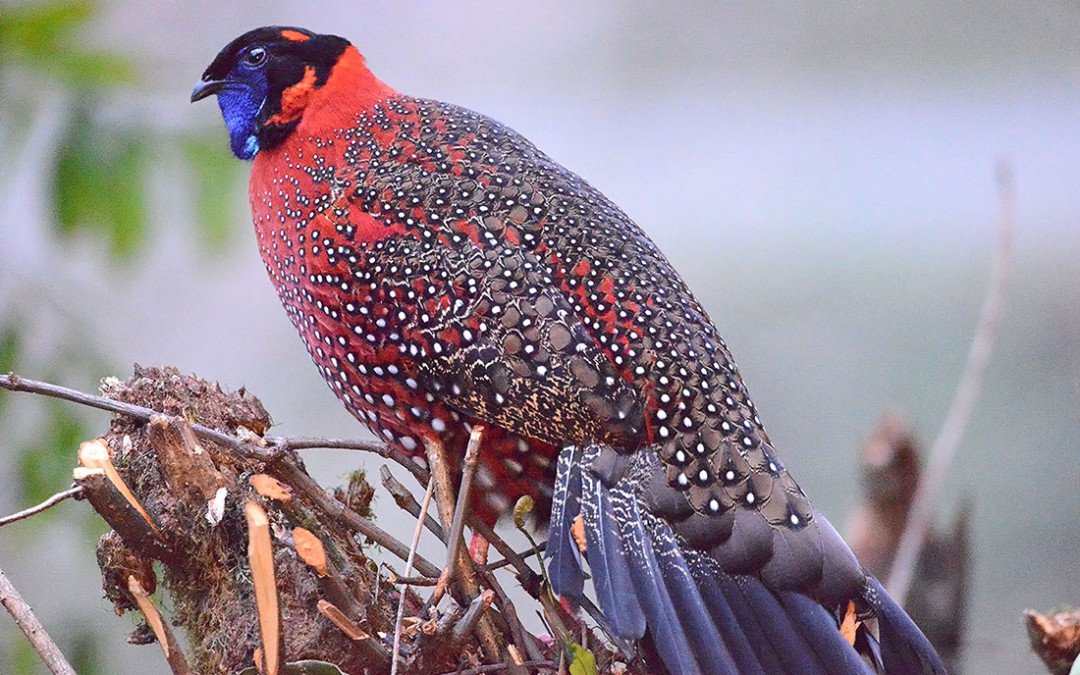
Sated after a fulfilling day of birding we reached our campsite, just beyond Namling. We had been advised to camp lower and travel higher for birding as the weather would be milder and that certainly was very good advise. Having tea and drinks in the open, listening to the sounds of White crested Laughingthrushes settling in for the night and the Mountain Scops Owl just waking; having an Asian Barred Owlet sit on a field post and a fire-fly lazily waft in the air – it was quite magical and perfectly comfortable and we were all relieved to discover we had not become old and crotchety and grumbly and non-adventerous. In fact we were quite spoilt and pampered at camp by a very able chef who even managed to bake a cake for us on the last day. So after a good night’s rest, we headed back up to Sengor to try and find the prize – the Satyr Tragopan. We all really wanted to see this bird and while Tashi had been reassuring about our chances, I was afraid that this mission might end up like those endless tiger safaris where all you see is a pug mark. We were driving up and it was barely light before Nik yelled STOP! What? Where? Satyr on the left side. Can you still see him? We scrambled to the side and tried desperately to get a look from inside the van, too scared to even open the door in case we spook him. After everyone had caught a glimpse, the door was slid as gently and silently as possible, and still without stepping down, we leaned out to get better views. The Tragopan obliged, he got onto a stump by the roadside and sat while we whispered and admired and then he flew into a tree. The van was rolled back in neutral, we jumped out and went to look for him. He sat on a branch and let out a call, the strangest call you’ve ever heard, like a wailing comic-book baby. He ruffled and shook his feathers in some sort of display and then disappeared. We were hooked, yeh dil mange more. The van was parked, binoculars, cameras and scopes were taken out while we waited for the light to get better and the Satyr to reappear. He kept teasing us. He would keep calling and while we fixated on the spot where it seemed to emanate from, he would silently creep to another spot and appear. He kept us rooted with tantalising glimpses and we decided to stay put and have breakfast, ready to share if he wanted a morsel. At one point he appeared on the road and Nik chucked away his sandwich in an attempt to quickly focus and get a picture but Wily Mr Tragopan was gone again. He called, we waited. Finally when we were ready to move on, he relented and came and sat back on the same branch. We ogled, clicked and scoped while he wailed, displayed, walked on the branch, turned and showed all sides……..Nothing beats breakfast with the Satyr Tragopan!
Our birding adventure continued for a couple of more days as we drove on to Korila – where we added the Gold-naped and Scarlet Finchs- to Trashigang where we finally got our wonderful monastery visit and so on through to Guwahati and our flights back home.
Our much awaited, much anticipated, much planned visit, had been an amazing experience- much as you would expect in wondrous Bhutan.
Happiness,
Sheila
Bird List – 21st March to 30th March 2014
1. Great Cormorant
2. Cattle Egret
3. Ruddy Shelduck
4. Common Merganser
5. Red-crested Pochard
6. Himalayan Griffon
7. Crested Serpent Eagle
8. Black Eagle
9. Mountain Hawk Eagle
10. Eurasian Kestrel
11. Common Buzzard
12. Blood Pheasant
13. Satyr Tragopan
14. Himalayan Monal
15. Kalij Pheasant
16. Black-necked Crane
17. Black-tailed Crake
18. Ibisbill
19. River Lapwing
20. Common Sandpiper
21. Rock Pigeon
22. Snow Pigeon
23. Oriental Turtle Dove
24. Spotted Dove
25. Barred Cuckoo-Dove
26. Mountain Imperial Pigeon
27. Common Hawk Cuckoo – Heard
28. Indian Cuckoo – Heard
29. Mountain Scops Owl – Heard
30. Asian Barred Owlet
31. Grey Nightjar – Heard
32. Large-tailed Nightjar – Heard
33. Himalayan Swiftlet
34. Fork-tailed Swift
35. White-throated Kingfisher
36. Blue-bearded Bee-eater
37. Common Hoopoe
38. Rufous-necked Hornbill – Heard
39. Great Barbet
40. Blue-throated Barbet
41. Yellow-rumped Honeyguide
42. Grey-capped Pygmy Woodpecker
43. Rufous-bellied Woodpecker
44. Crimson-breasted Woodpecker
45. Lesser Yellownape
46. Grey-headed Woodpecker
47. Nepal House Martin
48. White Wagtail
49. White-browed Wagtail
50. Citrine Wagtail
51. Olive-backed Pipit
52. Rosy Pipit
53. Rosy Minivet
54. Short-billed Minivet
55. Scarlet Minivet
56. Bar-winged Flycatcher Shrike
57. Striated Bulbul
58. Himalayan Bulbul
59. Red-vented Bulbul
60. Mountain Bulbul
61. Black Bulbul
62. Brown Dipper
63. Alpine Accentor
64. Altai Accentor
65. Rufous-breasted Accentor
66. Chestnut-bellied Rock Thrush
67. Blue Whistling Thrush
68. Scaly Thrush
69. White-collared Blackbird
70. Grey-winged Blackbird
71. Ashy-throated Warbler
72. Lemon-rumped Warbler
73. Grey-hooded Warbler
74. Chestnut-crowned Warbler
75. Black-faced Warbler
76. Broad-billed Warbler
77. Whistler’s Warbler
78. Rufous-gorgetted Flycatcher
79. Verditer Flycatcher
80. Grey-headed Canary Flycatcher
81. Golden Bush Robin
82. Oriental Magpie Robin
83. Black Redstart
84. Hodgson’s Redstart
85. White-throated Redstart
86. Blue-fronted Redstart
87. White-capped Water Redstart
88. Plumbeous Water Redstart
89. Pied Bushchat
90. Grey Bushchat
91. Yellow-bellied Fantail
92. White-throated Fantail
93. White-throated Laughingthrush
94. White-crested Laughingthrush
95. Striated Laughingthrush
96. Rufous-vented Laughingthrush
97. Bhutan Laughingthrush
98. Black-faced Laughingthrush
99. Chestnut-crowned Laughingthrush
100. Streak-breasted Scimitar Babbler
101. Slender-billed Scimitar Babbler
102. Rufous-throated Wren Babbler
103. Rufous-capped Babbler
104. Golden Babbler
105. Green Shrike Babbler
106. Black-eared Shrike Babbler
107. Hoary-throated Barwing
108. Bar-throated Siva
109. Golden-breasted Fulvetta
110. Yellow-throated Fulvetta
111. Rufous-winged Fulvetta
112. White-browed Fulvetta
113. Rufous Sibia
114. White-naped Yuhina
115. Stripe-throated Yuhina
116. Rufous-vented Yuhina
117. Black-throated Parrotbill
118. Black-throated Tit
119. Coal Tit
120. Rufous-vented Tit
121. Rufous-fronted Tit
122. Green-backed Tit
123. Yellow-cheeked Tit
124. Yellow-browed Tit
125. White-tailed Nuthatch
126. Eurasian Treecreeper
127. Rusty-flanked Treecreeper
128. Green-tailed Sunbird
129. Black-throated Sunbird
130. Fire-tailed Sunbird
131. Streaked Spiderhunter
132. Fire-breasted Flowerpecker
133. Oriental White-eye
134. Long-tailed Shrike
135. Grey-backed Shrike
136. Black Drongo
137. Ashy Drongo
138. Yellow-billed Blue Magpie
139. Grey Treepie
140. Black-billed Magpie
141. Spotted Nutcracker
142. Red-billed Chough
143. Large-billed Crow
144. Great Myna
145. Common Myna
146. Chestnut-tailed starling
147. Little Bunting
148. Plain Mountain Finch
149. Dark-breasted Rosefinch
150. White-browed Rosefinch
151. Red Crossbill
152. Brown Bullfinch
153. White-winged Grossbeak
154. Golden-naped Finch
155. Scarlet Finch
156. Russet Sparrow
157. Eurasian Tree Sparrow
Recent Comments