
Nikhil and I returned last evening from an Easter weekend trip to
Dhikala, Corbett National Park. The birding was delightful and the
forest looked phenomenal, in fact a trip to Corbett is worth it simply
for the amazing jungle habitat. At the moment there is a late spring
bloom in the air and the scene is painted in all the shades of green
and yellow and russet. The trees have dropped their last year’s
foliage and the floor is carpeted with peachy orange leaf litter that
looks like sunshine on the ground. It covers the park as far as you
can see and only the road you are travelling upon cuts a swathe
through it. Tall Sal trees line the sides of the road, bending inwards
to form an arch with some of the top branches intertwining like locked
antlers of sparring stags. As you drive through you are serenaded
with bird song. This is an incredibly noisy forest with clamorous
birds vying for attention – Jungle Fowls are crowing, Peacocks are
dancing, Spangled Drongoes and White Crested Laughing Thrushes
vociferously race through the thicket, woodpeckers are hammering,
bulbuls are singing in fluid tones accompanied by Magpie Robins, Blue
throated Barbets perch on the topmost branch so that their sound
travels, Indian Cuckoos and Koels announce their presence, Savannah
and Long-tailed Nightjars are discovered by their calls, while
Pallas’s and Lesser Fishing Eagles soar with plaintive screams. (bird
list at end)
On our way in to Dhikala we stopped at Ghairal and were greeted by the
sight of jeeps jamming the road, “Just….abhi….three tiger cubs
went in….” The story of my experience of tiger watching in Corbett
can be summed up in those two words, it’s always just abhi the tiger
crossed, or lay down, stalked, hunted, marked territory, scratched,
mated, you name it, but its always just abhi and I missed it! Thank
god I came to Corbett to bird and the highlight of that was a lifer
for Nikhil and I, shown to us by our friend Sumit Chugh. He had come
in a day earlier and when asked what he had seen so far, he showed us
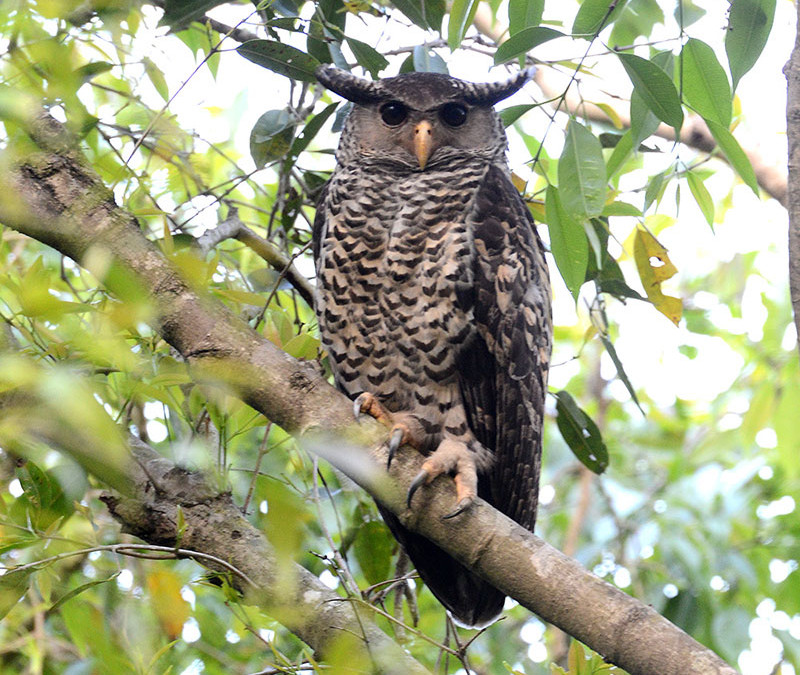
pictures of the most beautiful dark-eyed Spot Bellied Eagle Owl. All
disappointment with Panthera tigris was forgotten as he promised to
take us to the very tree the next morning. And there they were, a pair
of large owls, with dark penetrating eyes and long ear tufts, staring
down at us from two different trees. Well camouflaged and hidden in
the foliage, they were difficult to spot, only their shape giving them
away. Once found, we couldn’t take our eyes off them, waiting for them
to turn and reveal more. We spent a few minutes with them and then,
not wanting to disturb them too much, we drove away. Not quite
satiated and hoping that they might have moved to a lower branch and
clearer position, we went back in the afternoon for another look. One
of them was a little lower, though no clearer, and as we searched for
its mate a clacking of the beak sound revealed a nervous juvenile,
creamy white feathers with brown spots and black eyes, staring at us.
We found its other parent as well sitting out on a branch and keeping
an eye on junior. A few photographs and much ogling later, we drove
away, very happy to have met this family.
The next morning’s safari, as we rounded a bend from the chaur, we
came across two jeeps – “Just…..abhi…..a cub crossed and went, we
are waiting for the second” This was going to be another one of those
days…we waited, a Sambhar was going crazy on the side the cub had
gone to, while a few calls were coming from the other side as well,
giving us hope that the second one may indeed appear. The Sambhar was
so insistent that we decided to abandon post and check on the first
cub and so began the runaround, one jeep pointing to call from one
direction, another the other way, you get the general picture. After a
little while of raising dust we settled back to our original post and
decided to wait and birdwatch. A few more jeeps joined us and soon we
had a long line behind us. No tiger is going to come out now I thought
and gave up on it and then the passengers in the first jeep on the
other end got animated. Camera was raised and binocular focused as
they mimed tiger walking in the bushes, heading towards us. Another
long wait and I thought he might have just decided to rest and cross
after our time was up when another jeep’s passengers got excited! Dare
one hope? I was standing on the seat, binoculars searching when
suddenly two eyes were looking back at me! The tiger cub tentatively
peered through the bushes and half ducked on spotting us. I quickly
crouched down, trying to make myself inconspicuous and
non-threatening. He turned and walked and I could see his stripes move
through the bushes. Just ahead of our jeep, he poked out his head,
looked around uncertainly and then decided to be brave and walk
across. The dappled sunlight falling through the sal trees reflected
on his golden coat, sometimes in the sun and sometimes in the shade.
He walked, paused and looked, and then spooked, bounded across.
Everyone exhaled and looked at each other with big smiles. A new jeep
came charging in and when its passengers looked askance, I ruefully
smiled – “Just….abhi…..”
Happiness,
Sheila
Bird List
1. Black Francolin
2. Red Junglefowl
3. Kalij Pheasant
4.Indian Peafowl
5. Wooly-necked Stork
6. Black-necked Stork
7. Pond Heron
8. Grey Heron
9. Cattle Egret
10. Little Egret
11. Intermediate Egret
12. Great Egret
13. Black-winged Kite
14. Black Kite
15. Osprey
16. Pallas’s Fish Eagle
17. Lesser Fish Eagle
18. Oriental Honey-buzzard
19. Red-headed Vulture
20. Crested Serpent Eagle
21. Shikra
22. Bonelli’s Eagle
23. Booted Eagle
24. Changeable Hawk Eagle
25. White-breasted Waterhen
26. Great Thick-knee
27. Pied Avocet
28. River Lapwing
29. Red-wattled Lapwing
30. Little-ringed Plover
31. River Tern
32. Common Pigeon
33. Oriental Turtle Dove
34. Eurasian Collared Dove
35. Red Collared Dove
36. Spotted Dove
37. Laughing Dove
38. Yellow-footed Green Pigeon
39. Emerald Dove
40. Plum-headed Parakeet
41. Indian Cuckoo
42. Eurasian Cuckoo
43. Common hawk Cuckoo
44. Spot-bellied Eagle Owl
45. Brown Fish Owl
46. Large-tailed Nightjar
47. Savanna Nightjar
48. Indian Roller
49. Dollarbird
50.Stork-billed Kingfisher
51. White-throated Kingfisher
52. Common Kingfisher
53. Pied Kingfisher
54. Green Bee-eater
55. Blue-tailed Bee-eater
56. Chestnut-headed Bee-eater
57. Indian Grey Hornbill
58. Blue-throated Barbet
59. Lineated Barbet
60. Rufous Woodpecker
61. Grey-capped Pygmy Woodpecker
62. Streak-throated Woodpecker
63. Grey-headed Woodpecker
64. Lesser Goldenback
65. Rosy Minivet
66. Long tailed Minivet
67. Bay-backed Shrike
68. Long-tailed Shrike
69. Spangled Drongo
70. Black Drongo
71. Black-hooded Oriole
72. Maroon Oriole
73. Asian Paradise-flycatcher
74. Rufous Treepie
75. House Crow
76. Indian Bushlark
77. Oriental Skylark
78. Himalayan Bulbul
79. Red-whiskered Bulbul
80. Red-vented Bulbul
81. Black Bulbul
82. Common Tailorbird
83. Jungle Babbler
84. White-crested Laughingthrush
85. Oriental White-eye
86. Chestnut-bellied Nuthatch
87. Jungle Myna
88. Common Myna
89. Bank Myna
90. Chestnut-tailed Starling
91. Blue Whistling Thrush
92. Oriental Magpie Robin
93. Black Redstart
94. Common Stonechat
95. Pied Bushchat
96. Blue-capped Rock Thrush
97. Purple Sunbird
98. House Sparrow
99. Red Avadavat
100. Citrine Wagtail
101. Yellow Wagtail
102. Grey Wagtail
103. White-browed Wagtail
104. Paddyfield Pipit
105. Tree Pipit
106. Common Rosefinch
107. White-capped Bunting
Mammals
1. Bengal Tiger
2. Asian Elephant
3. Sambhar
4. Spotted Deer
5. Hog Deer
6. Barking Deer
7. Wild Boar
8. Jackal
9. Rhesus Macaque
10. Langur
Reptiles
1. Mugger
2. Gharial
3. Turtle
Butterflies ( 15 minutes at the Palm Trees)
1. Plain Tiger
2. Common Mormon
3. Common Crow
4. Common Rose
5. Blue Tiger
6. Sailer
7. Blue Crow
8. Yellows
9. Blues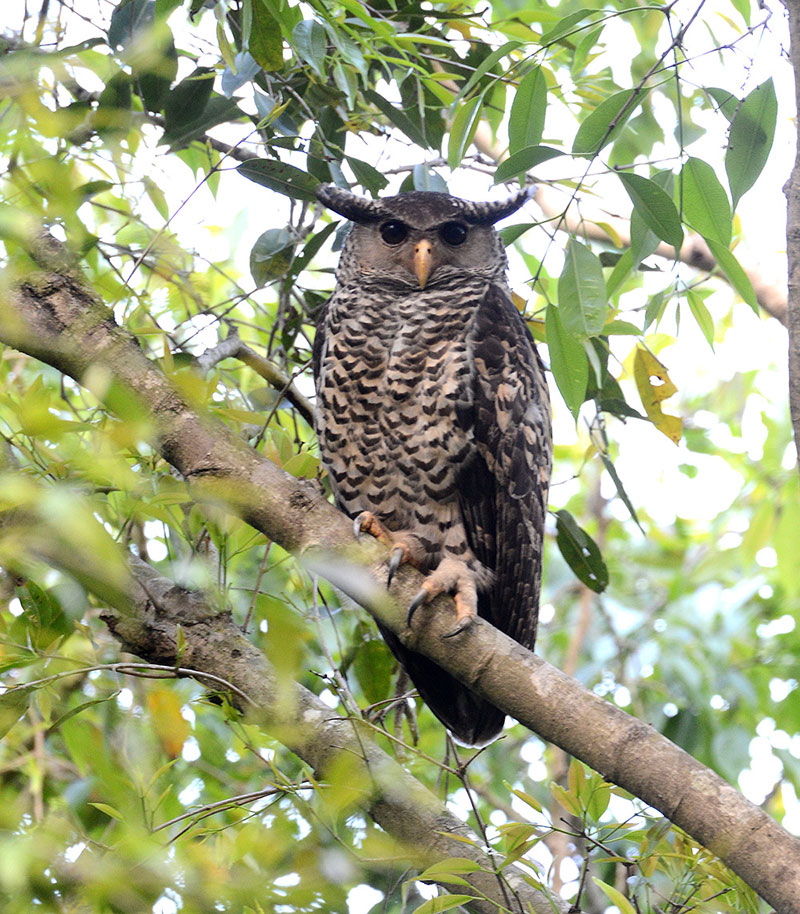
Recent Comments